
Today, we figure out what is the first TV show or movie to do a plot involving computer dating.
In “When We First Met”, we spotlight the various characters, phrases, objects or events that eventually became notable parts of pop culture lore, like the first time that JJ said “Dy-no-MITE” or the first time that Fonzie made the jukebox at Arnold’s turn on and off by hitting it.
June will be When We First Met Month!
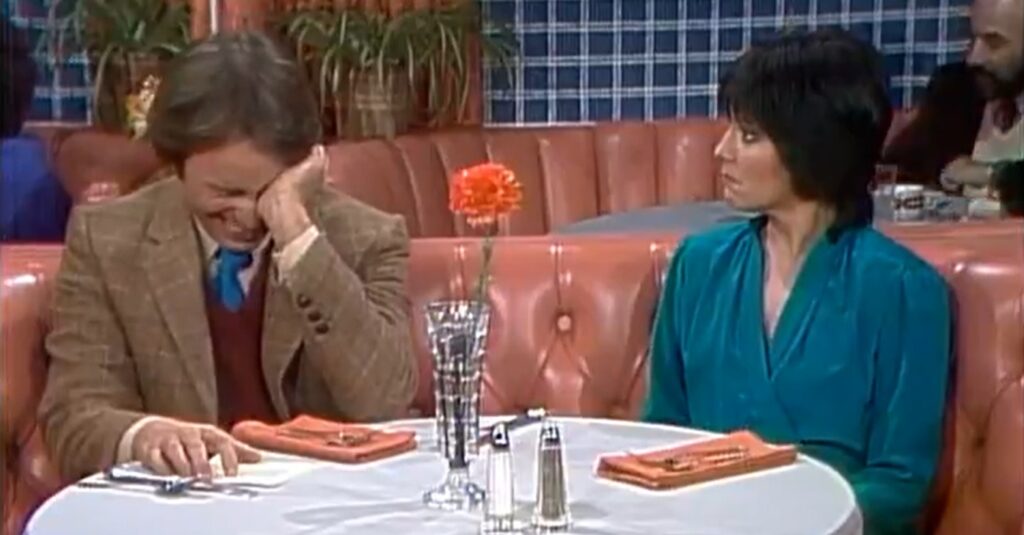
A regular plot for over a decade in TV sitcoms was a computer dating plot, where a computer makes an unlikely match, like Jack and Janet being paired with each other on an episode of Three’s Company (hence the featured image). However, reader Don S. wanted to know when this sort of plotline was first used in either a movie or a TV show. Let’s see what we can see!
Now, as soon as computers became practical things in the 1940s, they were used for computer dating, but only as a sort of gimmicky thing. For instance, one of the earliest TV appearances where computer dating was discussed was an episode of People Are Funny in 1956, where Bill Harper and Dorilla Dufresne appeared as a couple matched by UNIVAC.
However, it was not until 1964 that the first commercial computer service began in London, called the St. James Computer Dating Service. Some Harvard students launched the first American version the following year.
Okay, so that’s really where we’re looking, as when computer dating went COMMERCIAL, that’s when it really became a “thing” for TV shows (movies took longer, but in 1960, there WAS a movie involving a computer choosing the new head of the science department at a college, and it chose a former stripper-turned-scientist in Sex Kittens Go to College, a Mamie Van Doran vehicle).
First off, though, let me note that there was a 1961 episode of My Living Doll (a short-lived sitcom starring Bob Cummings as a Bob McDonald, a psychiatrist who is given control of a robot, played by a young Julie Newmar, to protect her from the government) where Bob uses Newmar’s robot brain to find the perfect date for his best friend, Peter (played by Jack Mullaney, who was obsessed with the robot, “Rhoda,” so Bob needed to find him a new date) (here is Peter and Rhoda in the episode)
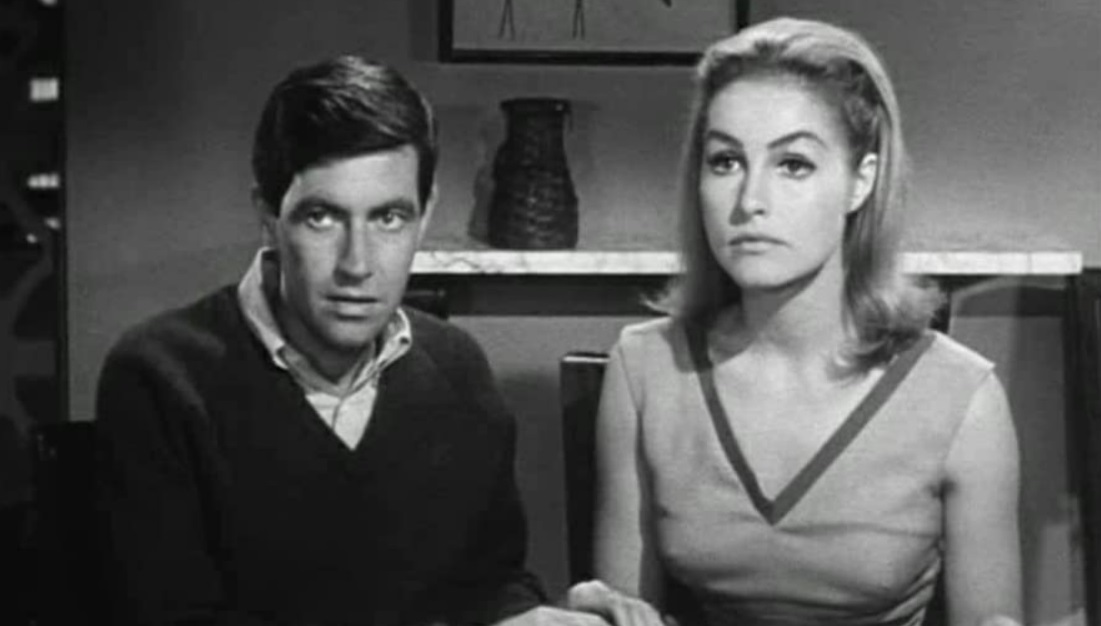
That episode, dubbed “The Love Machine,” is sort like computer dating, but not REALLY, right? I think we all know what we’re thinking when we say computer dating plots, and that wasn’t until 1965’s My Three Sons episode, “Steve and the Computer,” where the engaged eldest son on the show, Mike (Tim Considine) and his fiancée, Sally (Meredith MacRae) are dismayed to see that a computer dating service didn’t pair them together.
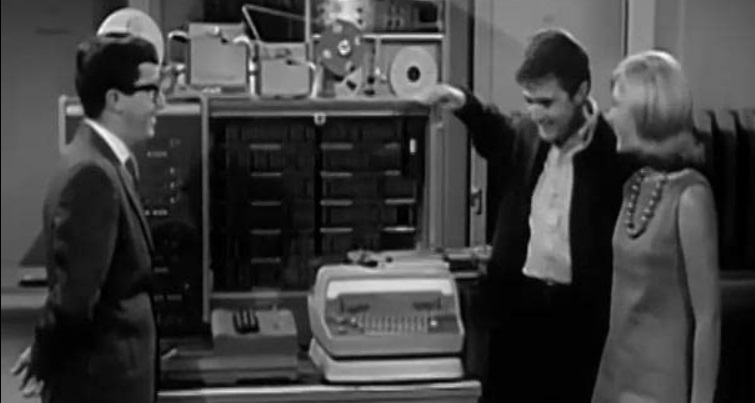
Steve (Fred MacMurray) then has a dumb dream about machines telling everyone what to do. My Three Sons would go back to the computer dating well in Season 8.
A couple of months after the My Three Sons episode, Bob Newhart starred in a TV movie about a guy using a computer to pick out a wife.
By 1968, literally half a dozen TV shows had done computer dating plotlines.
EDITED TO ADD: My pal Neil below noted that there was an unaired Archie pilot in 1964 that used a computer to work as a dating service (here is Betty, Archie and Veronica trying to convince teens to pick a card that could then be punched out with their dating data)…
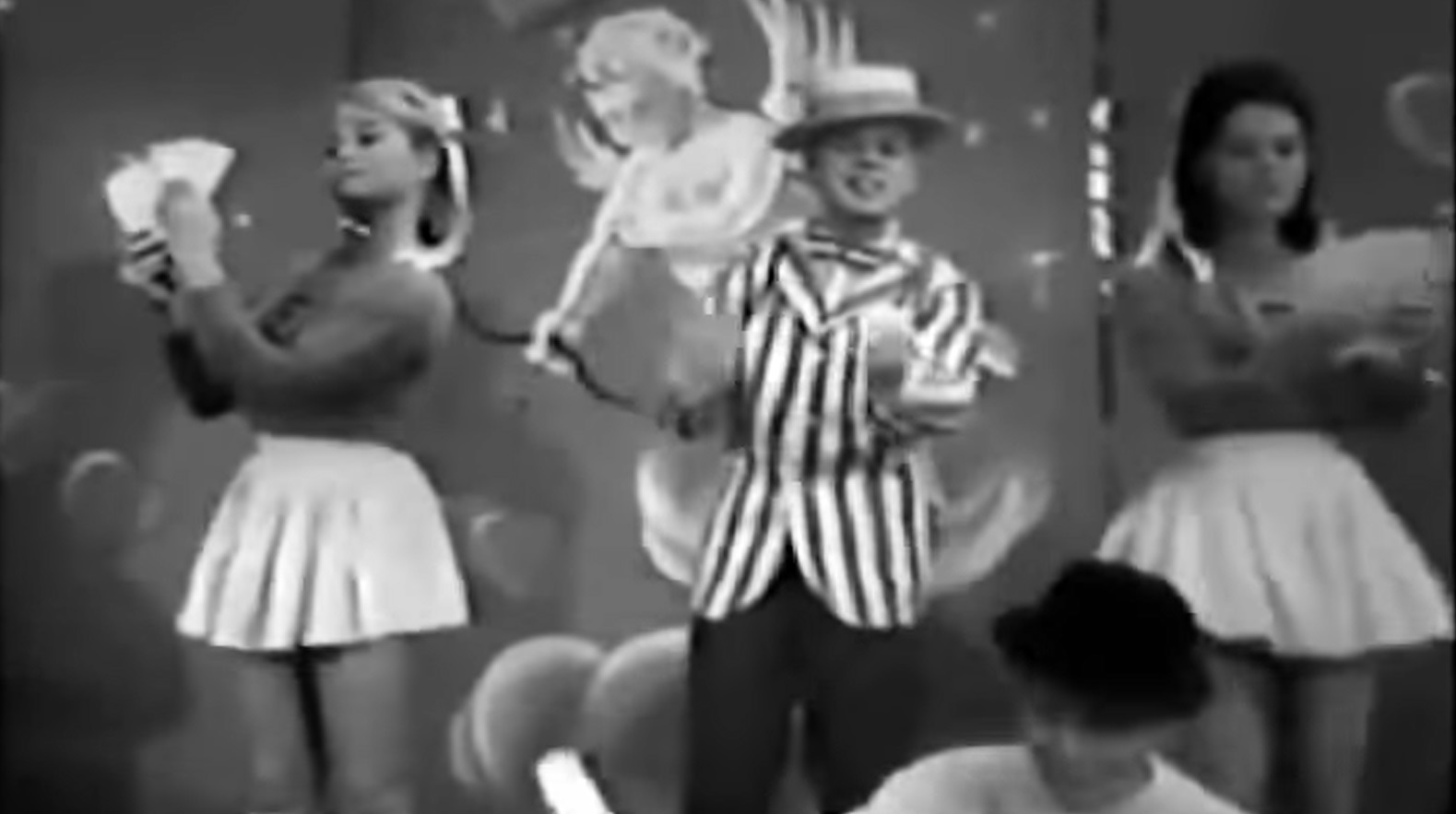
It didn’t actually AIR in 1964 (which is how I missed it), but I think you could easily argue that it should count over the My Three Sons episode. I’ll let you folks figure that out for yourself!
Thanks for the question, Don!
Okay, folks, I’d love to hear your suggestions for this month of pop culture firsts. If you have a suggestion for a future edition of When We First Met, drop me a line at brianpoprefs.com!








I’m not sure exactly what year it was, but in the very early 60’s, there was a pilot for an Archie tv series that did an exact computer-as-date-matching plot. The pilot didn’t and so the producers move on, and their next pilot project was Bewitched.
Thanks, Neil, I was thrown by it not airing, but yep, that pilot was done in 1964! I’ll add that in there as an option.
People always comment on how new technologies (especially cell phones) kill certain types of plot points or tropes, but I’ve always been more interested in what new kinds of plots can now only happen thanks to these technologies.
I was going to note the computer-dating plotline on “I Dream of Jeannie,” but it was relatively late (1969) AND it wasn’t particularly computer-y (the woman who ran the place realized Jeannie was looking for a date for an astronaut, so she set herself up on the date with Major Healey instead).
I caught a little bit of a “Benson” the other night (“Human Element”) in which the very 1980s robot could interact with humans, cook and even write on at least a ChatGPT level, and I watch way too much “Three’s Company,” so my two suggestions for this feature are:
— First TV or movie in a contemporary setting to have an authentic, believable real-world robot (so nothing set in the future, and nothing like that “Benson” episode that we could look at 40 years later and say “Robots STILL can’t do all that”).
— First TV or movie to do the “ATM spits out way way too much money” plot. (I know “Three’s Company” did it.)
The instant that I saw the banner to this entry, I thought of the My Three Sons episode, “Steve and the Computer”, so I was gratified to see it as your selection.
Aye, the dream sequence in the episode is over the top, but it’s still one of my (and the Good Mrs. Benson’s) favourite episodes of the series.
For those who came in late, the thrust of the episode occurs when, on a lark, eldest Douglas son, Mike, and his fiancée, Sally, submit completed questionnaires to a dating-service computer. They expect that the computer will find them a perfect match. However, as Mr. Cronin indicated, the computer finds them unsuitable for each other, and they are dismayed.
On a hope that the computer is unreliable, Mike asks his father to fill out a questionnaire for himself and another with the answers his late wife (Mike’s mother) would have entered. Those answers are fed into the machine, and it reports that Steve and his wife were an almost perfect match.
This dejects Mike to the point in which he is ready to call off the engagement—until Steve calls him up to the attic and shows him a letter that Louise had sent to Steve during their engagement. I won’t reveal the result, but the upshot is that there are things about the human condition that a computer cannot assess or attribute.
It’s notable, as this is one of the rare episodes that involves Steve’s late wife.
This was a fun read — I’d always assumed the computer dating sitcom trope started in the late ’70s or early ’80s, so seeing it traced back to the 1956 People Are Funny episode with Bill Harper and Dorilla Dufresne matched by UNIVAC was genuinely surprising. It makes sense that commercial services like the St. James Computer Dating Service in 1964, followed by the Harvard students’ American version in 1965, were what pushed the idea into mainstream pop culture. I’d be curious whether the 1960 film you mention was actually the first movie to use the plot, or if it just flirted with the concept without making the match the centerpiece. The Three’s Company example is a perfect illustration of how the gag worked best on TV, where a mismatched couple could generate a whole episode’s worth of awkward comedy.
Great deep dive into pop culture history! This reminded me of a handy resource I use when planning themed events or retro tech-themed calendars—like for tracking anniversaries of iconic sci-fi moments (e.g., that 1964 Archie pilot or *My Three Sons*’ “Steve and the Computer”). If you ever need a clean, customizable blank calendar—2026-dated or undated, Monday/Sunday start, A4/Letter, with space for notes and holidays—I’ve found this free printable tool super helpful. Just click any day to type, then download a print-ready PDF. Perfect for fandom planners, educators, or anyone who loves organizing pop culture milestones!
Great deep dive into pop culture history! This reminded me of another fun, nostalgia-filled resource: if you love classic TV and film trivia—and want printable puzzles to enjoy while reminiscing—check out free, customizable Sudoku puzzles. No sign-up, no ads—just clean PDFs ready for printing or solving on-screen. Perfect for fans who appreciate mid-century tech quirks *and* a satisfying mental break!
Great deep dive into pop culture history! While reading about early computer dating plots, I couldn’t help but think how far we’ve come—from UNIVAC matchmaking in the ’50s to AI-powered architecture diagrams today. If you’re designing modern systems (not dating apps!), check out ArchitectureDiagramAI—it turns plain text descriptions into clean, professional cloud or network diagrams in seconds. No coding, no drag-and-drop fatigue—just instant visuals for engineers, architects, and DevOps teams. Perfect for documenting the infrastructure behind today’s streaming platforms, dating apps, or any tech-driven show featured on PopCultureReferences!
Great deep dive into pop culture history! While exploring early computer dating plots, it’s fascinating how much AI and automation have evolved—from 1960s TV gimmicks to today’s intelligent tools. If you’re designing modern digital workflows inspired by such cultural milestones, check out BPMN-AI: create professional BPMN 2.0 diagrams instantly with AI—generate flowcharts from text, import images, and export to XML/SVG/PNG. Perfect for visualizing process logic behind even the most futuristic dating algorithms!
Try BPMN-AI now
Great deep dive into pop culture history! While exploring early computer dating plots, I also found myself needing a reliable tool to calculate car payments—especially when budgeting for that dream classic car featured in so many vintage TV shows. If you’re comparing loan terms or checking how credit score affects monthly payments, try this free, real-time calculator: Car Payment Calculator. No clicks needed—just type and see amortization, rate comparisons, and term options instantly. Perfect for fans who love both retro tech *and* smart financial planning!
Great deep dive into pop culture history! This reminded me of how far tech-driven storytelling has come—from early computer dating plots to today’s AI transforming architecture. If you’re into real-world applications of AI, check out a tool that turns 2D floor plans into stunning 3D visualizations in seconds:
convertimageto3d.com
It’s like giving your blueprints a Hollywood-style upgrade—no coding, no rendering headaches. Perfect for designers, agents, or anyone who wants to impress clients with photorealistic spaces.
Fascinating deep dive into the origins of computer dating in pop culture! It’s wild to think how early TV and film imagined AI matchmaking—long before apps like Tinder or Hinge. Speaking of AI and smart matching, if you’re into modern tools that *actually* use AI to match ideas with outcomes, check out FloorplanAI: an AI floor plan generator that turns a simple sentence into a 2D layout or photorealistic 3D model in seconds—perfect for homeowners, agents, and designers. No UNIVAC required! Try it here
Fascinating deep dive into the origins of computer dating in pop culture! It’s amazing how early TV and film explored tech-driven romance—even before modern apps existed. If you’re inspired by this retro-futuristic theme and want to visualize such cultural milestones as engaging infographics (e.g., “Timeline of Computer Dating in Film & TV”), our AI-powered tool makes it effortless: just paste your research, pick a template, and generate shareable visuals in seconds. Perfect for educators, content creators, or pop culture bloggers looking to elevate their storytelling with data-driven design. Try it free today:
Transform your pop culture insights into stunning infographics
Great deep dive into pop culture history! This reminded me of another niche but essential tool for today’s digital world: validating international banking details. If you’re researching early tech in media (like those 1960s computer dating plots), you might also appreciate a reliable, MOD-97-compliant IBAN generator that supports 80+ countries and handles batch processing professionally. It’s the kind of precision tool that would’ve made those fictional dating algorithms look downright quaint. Check it out here:
IBAN Generator & Validator
What a fascinating deep dive into pop culture history! This kind of thoughtful, well-researched analysis is exactly why I love sites like Pop Culture References. While exploring vintage TV and film trivia, I also rely on practical tools for everyday teaching and learning—like generating clean, customizable multiplication charts in seconds. Whether you’re prepping lesson plans or just curious about cultural milestones, having the right resource makes all the difference. For educators and parents who need crisp, printable math aids fast, I highly recommend checking out this intuitive generator:
multiplicationchartprintable.app
Great deep dive into pop culture history! This reminded me of a handy tool I use when comparing stats across eras—like calculating how much dating tech adoption *actually increased* from the 1960s to today. For quick, transparent % increase calculations (e.g., “computer dating services grew 340% between 1965–1968”), I rely on this clean, no-signup calculator:
Percentage Increase Calculator
It shows the formula, visual chart, and plain-English result—super helpful for writers, researchers, or just curious fans. Free and instant.
Great deep dive into pop culture history! While researching computer dating plots, I also needed precise graph paper for sketching timeline visuals—and found an excellent free tool: printablegraphpaper.app. It lets you generate custom PDFs in seconds—34 grid styles (square, dot, isometric, hexagonal), adjustable spacing (1 mm to 2 inches), color/weight control, and A4/Letter support. No signup, no watermarks. Perfect for educators, designers, or anyone mapping out pop culture chronologies. Highly recommend for clean, print-ready grids!
Great deep dive into pop culture history! This reminded me of another fun tool for modern dating—and retirement—planning: a free Roth IRA calculator that checks eligibility, projects growth, and compares Roth vs. Traditional options. If you’re curious how tech reshapes personal decisions—from 1960s computer dating to today’s financial tools—it’s worth checking out how your future self might thank you for starting early. Try the Roth IRA calculator here—no login, no spam, just smart, instant insights.
Great deep dive into pop culture history! If you’re researching computer dating in film/TV—or comparing analytics tools to track audience engagement with such niche topics—you’ll love the curated, expert-vetted SimilarWeb alternatives at similarwebalternative.com. It cuts through the noise with clear feature comparisons, transparent pricing, and real traffic insights—perfect for content creators, marketers, or pop culture researchers measuring platform performance. No fluff, just actionable data to help you choose the right analytics tool for your next deep-dive project.
Great deep dive into pop culture history! This kind of niche, well-researched trivia is exactly what makes sites like this so valuable. If you’re building or testing apps that involve user matching—like dating platforms, recommendation engines, or even internal dev tools—you’ll need realistic test data fast. For that, I’ve found https://vccgenerator.top/ incredibly useful: a free, professional VCC generator supporting Visa, MasterCard, Amex, and more—perfect for safely simulating payments during QA without real cards. Highly recommend it for devs working on anything from dating apps to subscription services.
This is such a fun deep-dive into pop culture history! It’s fascinating how early TV and film embraced computer dating as a plot device—even before most people owned computers. If you love nostalgic tech themes and want to relax while exploring that era, try pairing this article with some classic 60s-style ambient sounds. I’ve found the free white noise generator at white-noise-generator.com perfect for focus while reading about UNIVAC matches and *My Three Sons* dream sequences—100+ high-quality sounds, no login, completely free forever.