
Today, we figure out what is the first TV show or movie to do a plot involving computer dating.
In “When We First Met”, we spotlight the various characters, phrases, objects or events that eventually became notable parts of pop culture lore, like the first time that JJ said “Dy-no-MITE” or the first time that Fonzie made the jukebox at Arnold’s turn on and off by hitting it.
June will be When We First Met Month!
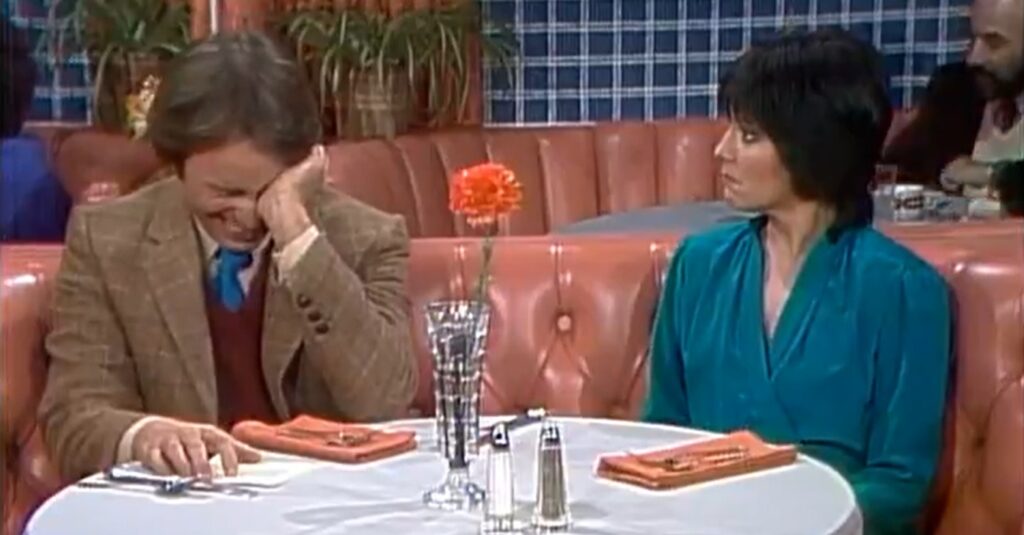
A regular plot for over a decade in TV sitcoms was a computer dating plot, where a computer makes an unlikely match, like Jack and Janet being paired with each other on an episode of Three’s Company (hence the featured image). However, reader Don S. wanted to know when this sort of plotline was first used in either a movie or a TV show. Let’s see what we can see!
Now, as soon as computers became practical things in the 1940s, they were used for computer dating, but only as a sort of gimmicky thing. For instance, one of the earliest TV appearances where computer dating was discussed was an episode of People Are Funny in 1956, where Bill Harper and Dorilla Dufresne appeared as a couple matched by UNIVAC.
However, it was not until 1964 that the first commercial computer service began in London, called the St. James Computer Dating Service. Some Harvard students launched the first American version the following year.
Okay, so that’s really where we’re looking, as when computer dating went COMMERCIAL, that’s when it really became a “thing” for TV shows (movies took longer, but in 1960, there WAS a movie involving a computer choosing the new head of the science department at a college, and it chose a former stripper-turned-scientist in Sex Kittens Go to College, a Mamie Van Doran vehicle).
First off, though, let me note that there was a 1961 episode of My Living Doll (a short-lived sitcom starring Bob Cummings as a Bob McDonald, a psychiatrist who is given control of a robot, played by a young Julie Newmar, to protect her from the government) where Bob uses Newmar’s robot brain to find the perfect date for his best friend, Peter (played by Jack Mullaney, who was obsessed with the robot, “Rhoda,” so Bob needed to find him a new date) (here is Peter and Rhoda in the episode)
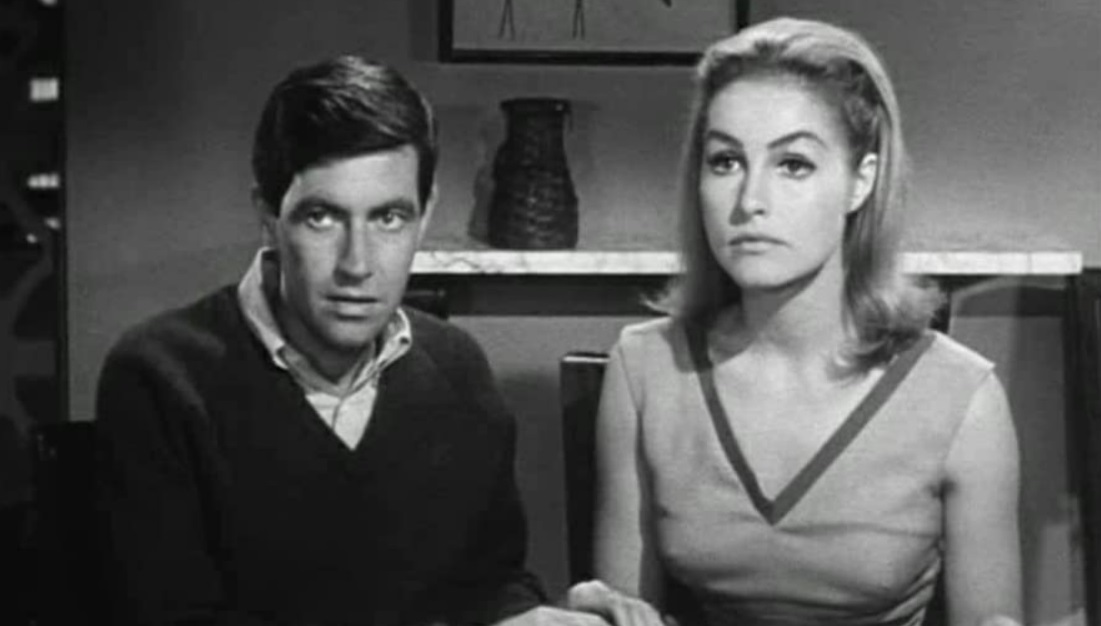
That episode, dubbed “The Love Machine,” is sort like computer dating, but not REALLY, right? I think we all know what we’re thinking when we say computer dating plots, and that wasn’t until 1965’s My Three Sons episode, “Steve and the Computer,” where the engaged eldest son on the show, Mike (Tim Considine) and his fiancée, Sally (Meredith MacRae) are dismayed to see that a computer dating service didn’t pair them together.
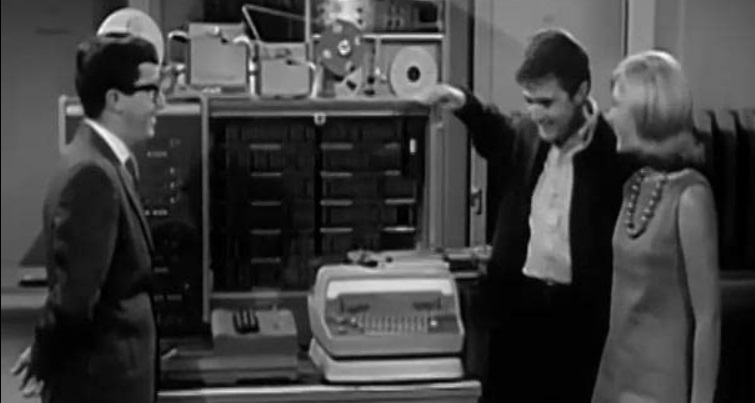
Steve (Fred MacMurray) then has a dumb dream about machines telling everyone what to do. My Three Sons would go back to the computer dating well in Season 8.
A couple of months after the My Three Sons episode, Bob Newhart starred in a TV movie about a guy using a computer to pick out a wife.
By 1968, literally half a dozen TV shows had done computer dating plotlines.
EDITED TO ADD: My pal Neil below noted that there was an unaired Archie pilot in 1964 that used a computer to work as a dating service (here is Betty, Archie and Veronica trying to convince teens to pick a card that could then be punched out with their dating data)…
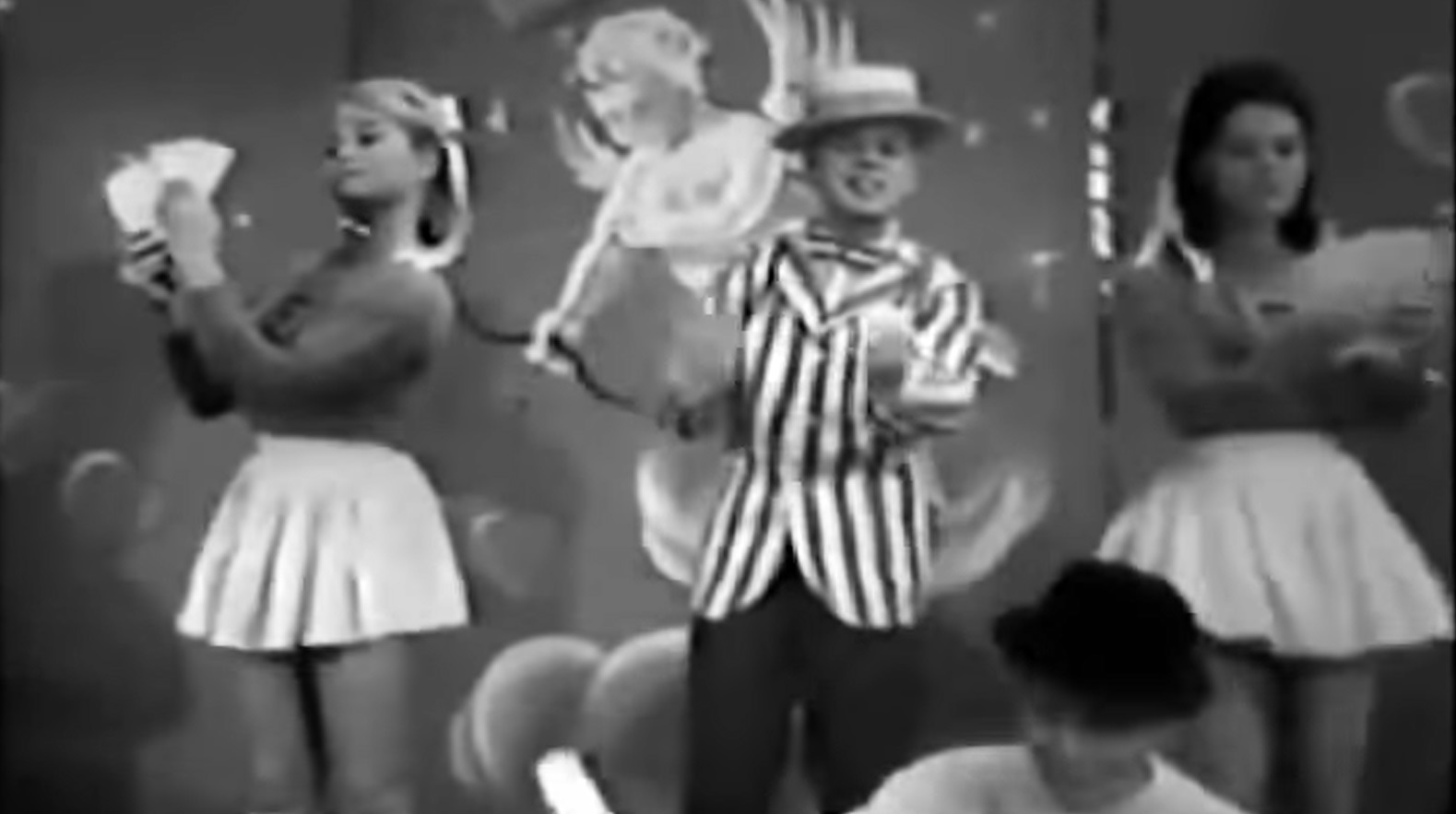
It didn’t actually AIR in 1964 (which is how I missed it), but I think you could easily argue that it should count over the My Three Sons episode. I’ll let you folks figure that out for yourself!
Thanks for the question, Don!
Okay, folks, I’d love to hear your suggestions for this month of pop culture firsts. If you have a suggestion for a future edition of When We First Met, drop me a line at brianpoprefs.com!




I’m not sure exactly what year it was, but in the very early 60’s, there was a pilot for an Archie tv series that did an exact computer-as-date-matching plot. The pilot didn’t and so the producers move on, and their next pilot project was Bewitched.
Thanks, Neil, I was thrown by it not airing, but yep, that pilot was done in 1964! I’ll add that in there as an option.
People always comment on how new technologies (especially cell phones) kill certain types of plot points or tropes, but I’ve always been more interested in what new kinds of plots can now only happen thanks to these technologies.
I was going to note the computer-dating plotline on “I Dream of Jeannie,” but it was relatively late (1969) AND it wasn’t particularly computer-y (the woman who ran the place realized Jeannie was looking for a date for an astronaut, so she set herself up on the date with Major Healey instead).
I caught a little bit of a “Benson” the other night (“Human Element”) in which the very 1980s robot could interact with humans, cook and even write on at least a ChatGPT level, and I watch way too much “Three’s Company,” so my two suggestions for this feature are:
— First TV or movie in a contemporary setting to have an authentic, believable real-world robot (so nothing set in the future, and nothing like that “Benson” episode that we could look at 40 years later and say “Robots STILL can’t do all that”).
— First TV or movie to do the “ATM spits out way way too much money” plot. (I know “Three’s Company” did it.)
The instant that I saw the banner to this entry, I thought of the My Three Sons episode, “Steve and the Computer”, so I was gratified to see it as your selection.
Aye, the dream sequence in the episode is over the top, but it’s still one of my (and the Good Mrs. Benson’s) favourite episodes of the series.
For those who came in late, the thrust of the episode occurs when, on a lark, eldest Douglas son, Mike, and his fiancée, Sally, submit completed questionnaires to a dating-service computer. They expect that the computer will find them a perfect match. However, as Mr. Cronin indicated, the computer finds them unsuitable for each other, and they are dismayed.
On a hope that the computer is unreliable, Mike asks his father to fill out a questionnaire for himself and another with the answers his late wife (Mike’s mother) would have entered. Those answers are fed into the machine, and it reports that Steve and his wife were an almost perfect match.
This dejects Mike to the point in which he is ready to call off the engagement—until Steve calls him up to the attic and shows him a letter that Louise had sent to Steve during their engagement. I won’t reveal the result, but the upshot is that there are things about the human condition that a computer cannot assess or attribute.
It’s notable, as this is one of the rare episodes that involves Steve’s late wife.
This fascinating deep dive into the origins of computer dating in pop culture—spanning from 1956’s *People Are Funny* to *My Three Sons* and beyond—reminds us how quickly storytelling latched onto emerging tech as both plot device and cultural mirror. Today, that evolution continues at lightning speed: instead of algorithms matching people, AI now generates entire video narratives on demand. If you’re intrigued by how far we’ve come from UNIVAC-powered pairings to real-time creative synthesis, check out the cutting-edge tools shaping the next wave of digital expression at https://zombieaitrend.com
This deep dive into the origins of computer dating plots is a fascinating look at how early tech captured pop culture imagination—much like today’s VPS hosting and self-hosting trends reflect our evolving relationship with digital autonomy. While vintage TV shows dreamed up matchmaking algorithms, modern users are building their own digital infrastructure from scratch. For those inspired by this history to explore hands-on tech control, https://dakule.com/ offers practical, beginner-friendly guides on VPS setup, self-hosted apps, and networking—turning nostalgic curiosity into real-world digital empowerment.
The unaired Archie pilot really does feel like it should count, since the concept was fully formed even if it never made it to air. Funny how quickly these plots became a sitcom staple once computers went commercial. I was actually messing with an ai flyer generator last week and had a similar “we’ve come so far” moment.
Great deep dive into pop culture history! It’s fascinating how early TV and film imagined computers shaping personal relationships—even before the internet existed. If you love exploring retro-futurism like this, you might also enjoy creating your own AI-generated visuals inspired by classic sci-fi dating plots. Try turning “The Love Machine” episode or *Sex Kittens Go to College* into a modern AI artwork in seconds—no coding, no login: CreateImage.online
Fun deep-dive into pop culture history! While reading about early computer dating plots, I couldn’t help but think of how far we’ve come—from UNIVAC matchmaking in the ’50s to AI turning your photo into a viral Bulin 47 freestyle video in seconds. If you love nostalgic tech moments *and* want to make your own shareable AI clip for TikTok or Reels, check out this cool fan tool:
Bulin 47 AI
Great deep dive into early computer dating in pop culture! This reminded me of how much fun it is to track down obscure but pivotal moments in media history. If you’re into retro-futurism, Aion 2 lore, or just love diving into niche game universes with rich worldbuilding and hidden easter eggs, check out [Aion 2 Vault](https://aion2vault.com/) — a growing hub for Aion 2 fans, featuring rare datamined content, timeline reconstructions, and community-driven theorycrafting. Perfect for those who geek out over “firsts” — whether in TV plots or MMO evolution.
Great deep dive into early computer dating in pop culture! It’s fascinating how quickly TV latched onto this tech-themed trope—especially when you consider how invisible Unicode formatting can quietly sabotage your own scripts or subtitles. If you’re cleaning up dialogue transcripts, captions, or even vintage TV show metadata before archiving or sharing, watch out for zero-width characters that might sneak in during copy-paste from PDFs or OCR tools. For quick, private, browser-based cleanup—no uploads, no tracking—try Zerowidth Cleaner:
https://zerowidthcleaner.com