
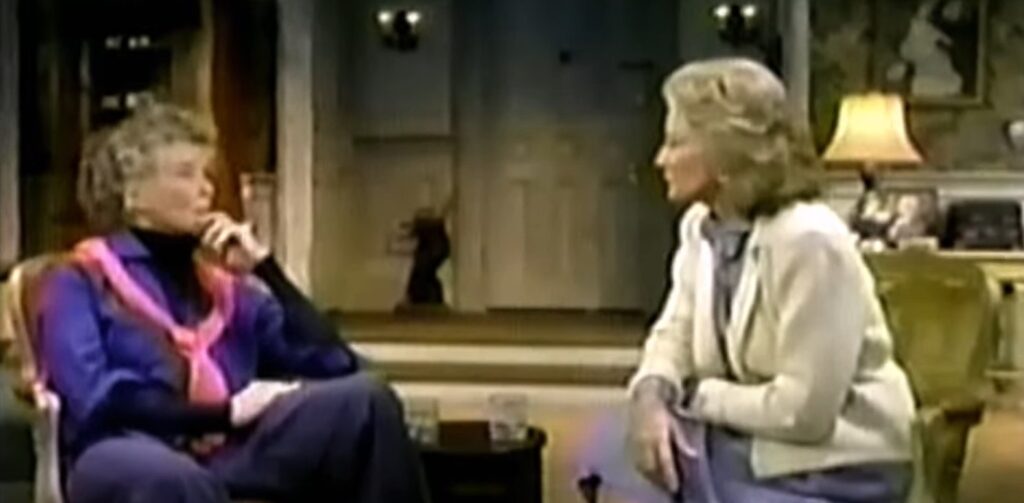
Today, we show the actual origins of what has become one of the most parodied interview questions of all-time.
This is Foggy Ruins of Time, a feature where I give you the cultural context behind once-topical references that have faded into the “foggy ruins of time.” To wit, twenty years from now, a college senior watching episodes of Seinfeld will likely miss a lot of the then-topical pop culture humor (like the very specific references in “The Understudy” to the Nancy Kerrigan/Tonya Harding scandal).
While Barbara Walters broke into the TV industry as a hard-hitting news interviewer, once she was famous, she then moved into the field of celebrity interviews, as well. This is a pretty standard thing in the history of TV news. For instance, even the great Edward R. Murrow, considered by many to be one of the best serious TV news journalists of all-time, famously had to do celebrity interviews back in the 1950s to help support his hard-hitting news (as a sort of “One for you, one for me” deal with the network. One hard-hitting news episode for every celebrity puff piece episode, or whatever the equation was, maybe it was 2-1 or 3-1 or whatever).
Celebrity interviews, while extremely popular, also occasionally get the reputation of being kind of pointless, the opposite of the hard-hitting interviews that people associate with news shows. One of the most famous example of the sort of nonsense question is the infamous “If you were a tree, what kind of tree would you be?” It was long associated with Barbara Walters, because technically it DID come from one of her celebrity interviews. However, the context of the original question was VERY different than how it has been used in the decades since as an example of a stupid question interviewers ask celebrities.
The question came up in Walters’ famous 1981 interview with Katharine Hepburn upon the promotion of the then-upcoming movie, On Golden Pond, a film Hepburn would win her fourth and final Academy Award for Best Actress. Hepburn got to talking about how she saw herself at this point in her life, and noted, “I’m a very strong… I’ve become a sort of, you know, thing.” Walters responded, “What?” Hepburn continued, “I don’t know what. A tree or something.” That’s the point where Walters asks, “What kind of a tree are you? If you think you’re a tree now.” Hepburn replied, “I hope I’m not an elm with Dutch elm disease, because then I’m withering. Everybody would like to be an oak tree. That’s very strong, very pretty.”
So you see? The context is key. Yes, she DID ask the question, but only because her subject brought the topic up. It made perfect sense in context, and was not a stupid question.
In the years since, though, stripped of context, it has become an example of a stupid celebrity question. Now you know the truth!
RIP, Ms. Walters.
Okay, folks, if you have suggestions for a future Foggy Ruins of Time, feel free to drop me a line at brian@popculturereferences.com!





Even in context, it’s a stupid question.
Nope, still a stupid question.
https://www.youtube.com/watch?v=Uoatg0CJxtM
Named bosses arrive on a schedule, and the last one ends the zone. afe6d348.
This is fascinating! I always wondered about the origin of that quirky interview question. It’s so interesting to see how Barbara Walters, a pioneer in news, also shaped celebrity interviews, reminding me of how diverse roles in media can be. Learning about the “Foggy Ruins of Time” concept and its relevance to pop culture references truly adds a new layer to understanding media history, almost like needing a ba 2 plus calculator online to figure out complex historical data points. Great read!
This is a fascinating dive into the origins of such a memorable, albeit parodied, interview question! It’s so interesting to see how these seemingly random pop culture moments tie back to significant figures like Barbara Walters and even Edward R. Murrow. Understanding the “Foggy Ruins of Time” concept makes me appreciate this kind of cultural context even more. Thanks for shedding light on this! For more great content, be sure to check out Block Poster.
This is such an insightful dive into the origins of that classic, often-parodied interview question! I love how you connect it to the broader history of TV news and how even serious journalists had to navigate celebrity interviews. It’s fascinating to see how something so commonplace now has such a nuanced past. It really makes you think about how quickly cultural references can fade, like trying to remember the exact dimensions for a square feet calculator when you haven’t used it in years. Great read!
Friends can share a co-op run from their own browsers. 430a0203.
This was such a fascinating dive into the unexpected origins of that quirky interview question! It’s wild how certain phrases become so iconic, only for their original context to get lost to time. I especially enjoyed the connection to Barbara Walters and the evolution of TV journalism – really puts things into perspective. Thanks for shedding light on another one of those “foggy ruins of time”! This kind of pop culture archaeology is something I always appreciate reading, and it reminds me of the great insights you can find at AI Rumpelstiltskin.
This is a fantastic dive into pop culture history! I’ve always wondered about the origin of that quirky “tree” question, and it’s fascinating to learn how it links back to Barbara Walters and the evolution of celebrity interviews. It really highlights how some phrases just become part of our collective consciousness, even if their roots are forgotten. Thanks for shedding light on these Image to Line Converter “foggy ruins of time”!
This is such a fascinating deep dive! I’ve always wondered about the origin of that quirky interview question, and it’s brilliant how you connect it to the broader history of TV journalism and the balance between hard news and celebrity fluff. It really puts those “foggy ruins of time” references into perspective. This kind of cultural context is exactly why I love reading your posts; it helps us appreciate the nuances of pop culture, much like how a good Cartoon Video Generator can add a fresh, engaging layer to storytelling. Thanks for another insightful read!
This is fascinating! I’ve always wondered about the origin of that quirky interview question. It’s so true how pop culture references fade over time, and this article does a great job of digging into the past. I especially loved the connection to Barbara Walters and the historical context of celebrity interviews. This article really helps Image Splitter the fog and clarify the past!
This is such a fascinating deep dive! I’ve always wondered about the actual origins of “If you were a tree, what kind of tree would you be?” and it’s brilliant how you trace it back through the evolution of celebrity interviews and even Barbara Walters’ career. It’s so true how quickly pop culture references can fade into the “foggy ruins of time,” and features like this are essential for keeping that context alive. Thanks for shedding light on such an iconic, and often parodied, question! I especially loved the parallel to Edward R. Murrow – really highlights how some things in media are truly timeless, even if the specific questions change. It’s a great example of how different elements Combine Image to create a bigger picture in cultural history.
This is such a fascinating deep dive into a pop culture staple! I’ve always wondered about the origins of “If you were a tree, what kind of tree would you be?” and it’s great to finally get the real story behind it. The point about how even serious journalists like Edward R. Murrow had to balance hard news with celebrity interviews to keep things running truly highlights the evolving landscape of media and audience engagement. It makes you think about the ‘equations’ of value, much like figuring out the best return on investment with a TVM Calculator – sometimes you have to do a bit of everything to make the overall project succeed. Thanks for shedding light on another one of those “foggy ruins of time”!